


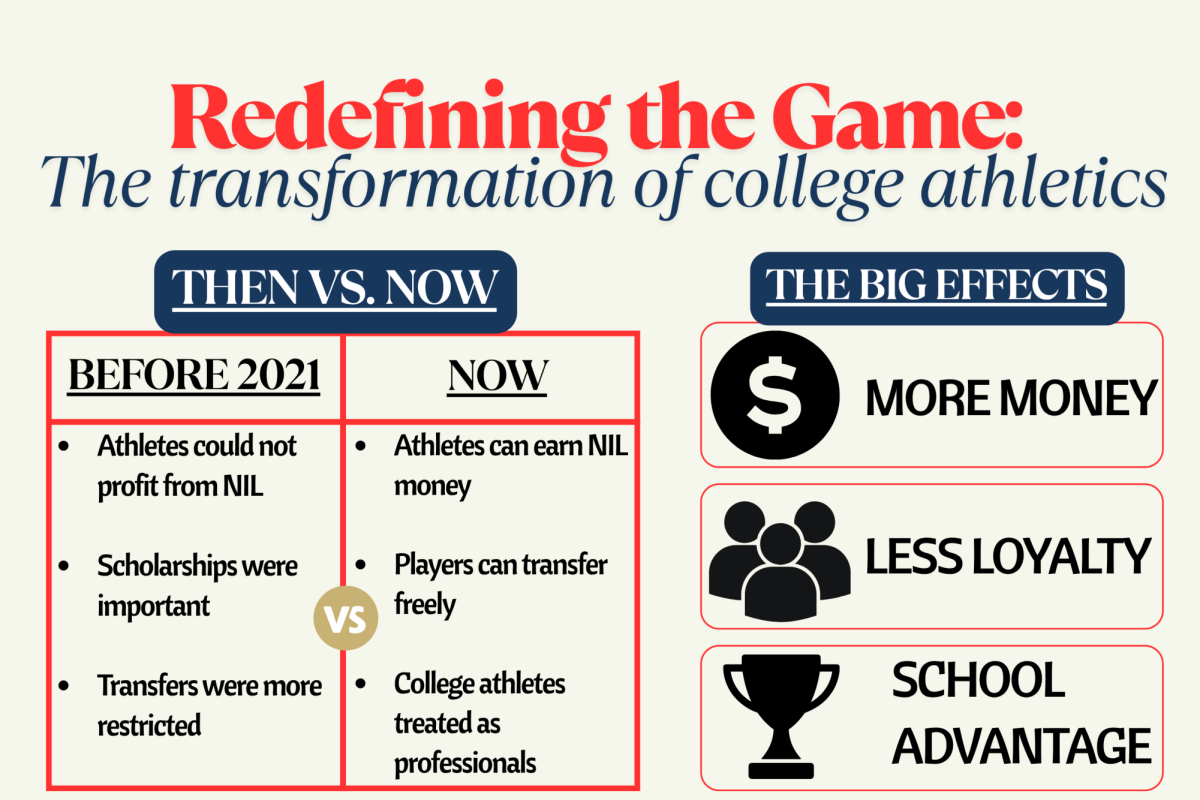
Before 2021, student-athletes weren’t able to make a dime off their talents at the collegiate level, while professional athletes were making millions of dollars. With the impacts of the Transfer Portal and NIL (Name, Image, and Likeness), college athletes are now treated at a professional level, allowing them to switch from whatever school they please and profit directly from their personal brands.
The Transfer Portal and NIL have created a form of “Free Agency” in college athletics as student-athletes are now allowed to travel freely to whichever college they desire, not based only on athletic opportunity but also potential earnings. With both the Transfer Portal and NIL, the traditional “student-athlete” experience has been modified significantly. Previously, going to college as an athlete gave the opportunity to receive a scholarship, earn a free education, and pursue an athletic career. However, now it is centered around going to the biggest schools with the most amount of money. NIL allows fans, boosters, and schools to pay athletes directly to join their school, which nearly removes loyalty towards programs and has coaches continuously having to “re-recruit” their rosters to keep players from entering the transfer portal for bigger deals.
Top collegiate athletes like Arch Manning, quarterback for the University of Texas, earn about 6.8 million dollars a year playing football from NIL deals. Some college athletes can make amounts comparable to first-round NFL draft picks, who may earn anywhere from 3 to 10 million dollars a year. This can lead players to stay in college longer, where they know that high pay is guaranteed, while being a top draft pick in the NFL draft leaves uncertainty. NIL has not only changed the landscape for athletes but also for schools, as it has increased the divide between “Power 4 Schools” and mid-major schools, as bigger schools with more financial resources can afford better talent, giving them a major advantage. This creates the value that the coaches can pursue players from other programs by offering large financial opportunities.
In 2024, the NCAA eliminated the punishment that required athletes who used the transfer portal to sit out for a year. The change has drastically affected the number of athletes who use the portal, as now more than ever, athletes are changing programs. About 6,700 Division One football players and 2,600 Division One men’s basketball players have used the portal this year. This is a substantial shift compared to only 1,100 players in all of Division One football who used the portal between the 23-24 season and 1,700 players in men’s basketball. Not only has the transfer portal changed the lives of current collegiate athletes, but also changed the lives of high school athletes. Coaches now look for players with experience instead of players who need development, which often leads to fewer scholarships and opportunities.
Through the effects of NIL and the Transfer Portal, college sports are now forever altered and have created quite a stir for many collegiate programs. Schools are now signing and treating players like professional athletes to significant contracts to come play for their school. So is NIL and the Transfer Portal welcome to stay in modern college athletics, or is it time to rethink and return to the former ruling?










K Morris • May 23, 2026 at 2:20 pm
Excellent piece of writing. The piece showed the difference between the former athletic program and the program of today .
We believe college athletics should return to the former.