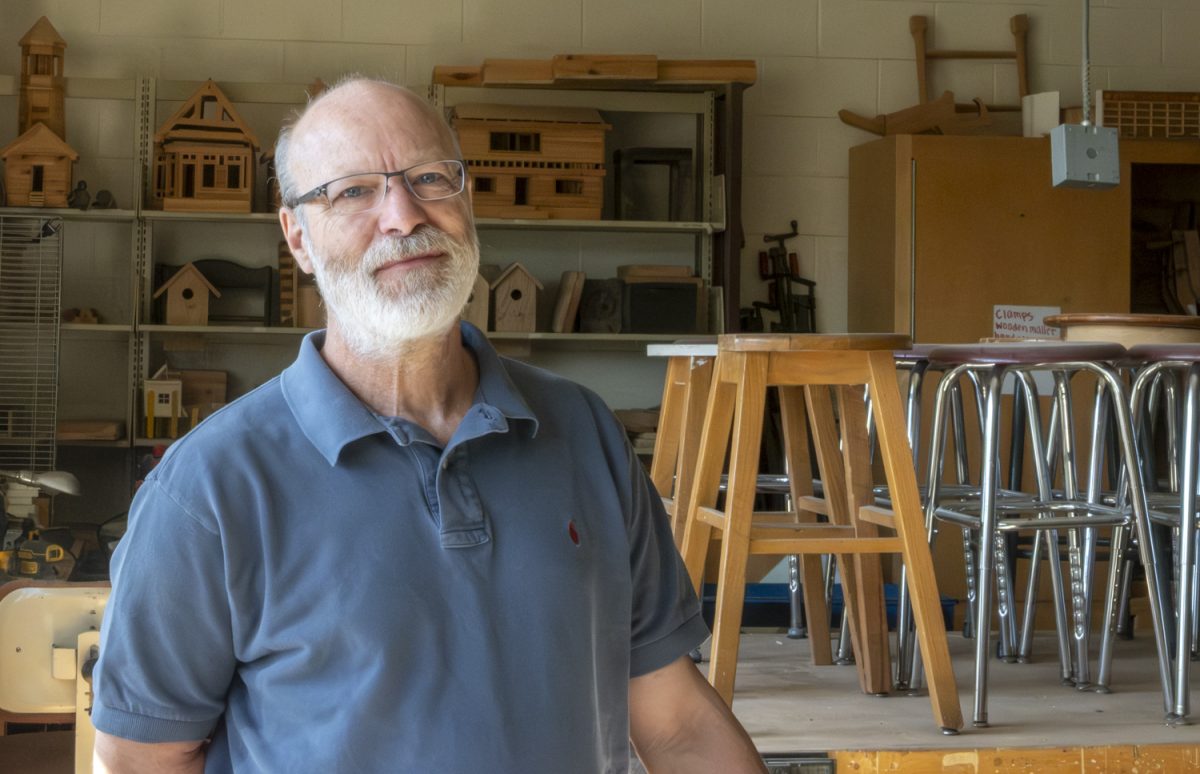



After four years of teaching at Algonquin and building connections with students through language, Spanish teacher Pauliny Smith has decided to switch careers in order to become a state police officer.
Citing her Brazilian identity and her fluency in multiple languages, Smith says that her priority has always been to uplift those around her and to foster appreciation of people from different backgrounds. As a child, she was very drawn to teaching, and was impressed by the Algonquin community after her student placement there.
“Being a teacher is something that I think was always going to be in my path for the future, ever since I was younger,” Smith said. “Honestly, the Algonquin community, it was and still is amazing. Everyone continues to be super kind in the community; I feel like what we have here really is something special.”
Smith grew up speaking Portuguese and also attended a Spanish immersion school until eighth grade. While these experiences drove her to become a language teacher, she also wanted to ensure that her students developed a full understanding of different languages instead of relying on just surface-level vocabulary.
“I was just used to being around different cultures [and being] immersed in different languages,” Smith said. “I really value the connections I was able to make being able to communicate with someone else, or just being able to be a part of a different culture. Everyone’s always saying, ‘I wish I was able to use the language, not just a few buzzwords here and there.’ And I want to try to be the teacher that actually teaches kids to use the language, not just learn a couple phrases just to get by.”
However, Smith also had a long-standing desire to work in law enforcement, and was inspired by her father, who is a police officer.
“I’ve always looked up to [my dad],” Smith said. “He’s my hero, and I’ve seen the other side of law enforcement that I think a lot of people don’t get the opportunity to see. I see past the uniform in a way, and I see all the sacrifices that he’s made for me and my brothers. But I also see the love and appreciation and dedication he has for his community while in uniform.”
Smith’s decision to switch careers took place after a lot of introspection, especially as she realized the outsized impact a police officer with deep knowledge of different languages and cultures could have on underserved communities.
“I’m just at a point in my life where I’m only four years into my teaching career, and I this idea of becoming a police officer and using language to help other people is something that been kind of creeping in the back of my mind, and I haven’t been able to shake it,” Smith said. “So I’m like, ‘You know what? Four years in, there’s no time like the present,’ and as cliché as that sounds, it’s so true. I figured now’s the time to kind of make a switch.”
Smith also hopes to shift pre-conceived notions about police officers in her upcoming role.
“I see a lot of things that are happening in the world, and I think I could use [my ability to] speak Spanish, speak Portuguese and the connections I’m able to build with people to shift that perspective that all members of law enforcement have a negative connotation,” Smith said.
The process of becoming a state police officer is not easy. Smith had to undergo medical exams, psychiatric evaluations, fitness tests and other assessments just to qualify for state police training, which takes six months to complete. Still, she is motivated to promote greater understanding and eliminate barriers which can raise tensions between civilians and law enforcement.
“You always hear stories about people who are like, ‘Oh my god, I can’t stand police officers,’” Smith said. “And I don’t even think it’s [because] they can’t stand police officers, they just unfortunately didn’t have a great experience. And that experience wasn’t even in the police officer’s control. It was that whole other bubble of language barrier or cultural barrier, so my hope is that I can give someone a good experience and kind of tackle that.”
While Smith is excited to start her new journey, she is also grateful for the support of her students and colleagues.
“When my students are like, ‘Oh, I love being in your class’ or, ‘You know, you’ve done this for me,’ I wish I could tell them you don’t realize what all of you guys have done for me as a person,” Smith said. “And this is what makes it worth it.”
Her compassionate teaching style has positively affected many students.
“Señorita Smith has impacted me as a student because she’s very caring, loving and kind,” junior Liv Gray said. “I never felt stressed in her class, and she has a lot of very caring qualities about her. I really appreciate that she cares not only about the quality of my work, but the quality of my mental state as a student.”
Ultimately, Smith hopes that her career switch will inspire other students to go down the path that makes most sense for them and gives them a sense of fulfillment.
“If it works out, amazing, if it doesn’t, it is what it is,” Smith said. “But it’d be a lesson that I would want to teach my students. Don’t be afraid to take risks. Just do it because you really never know what could happen if you don’t try.”