


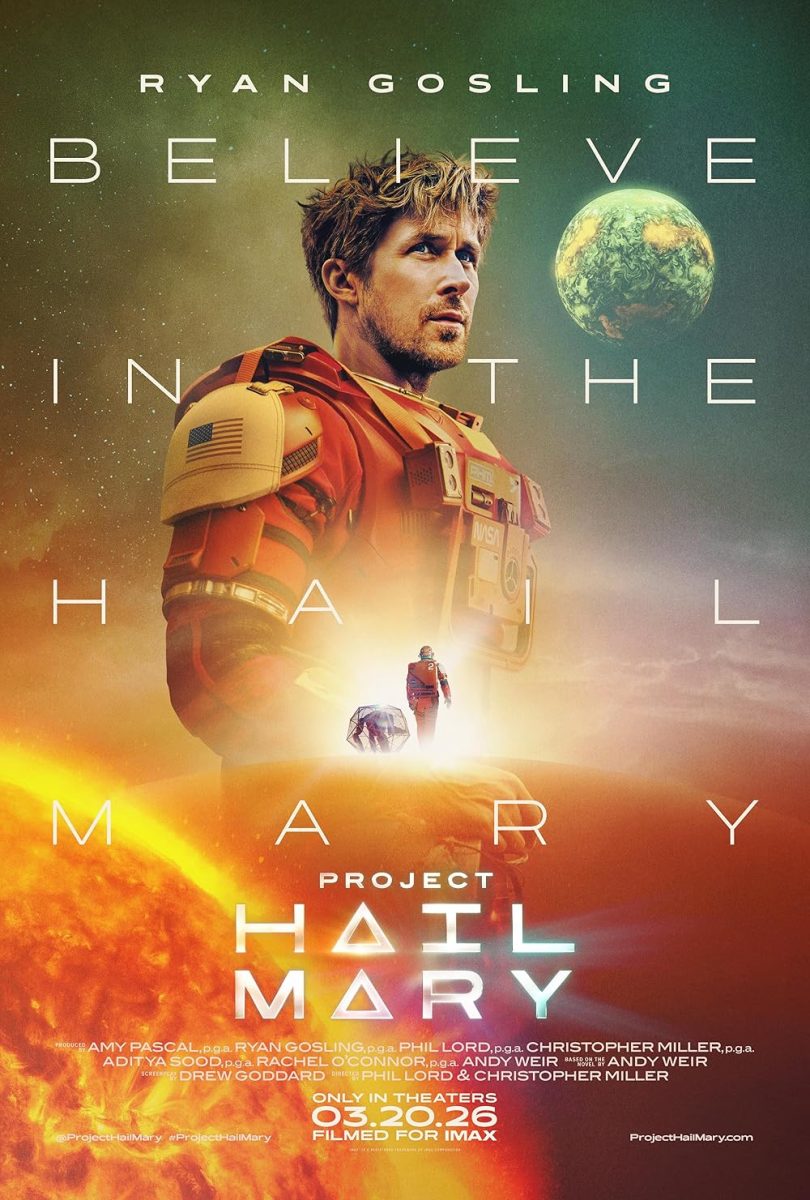
“Project Hail Mary” is the newest release from the directing duo Phil Lord and Christopher Miller, a smash hit adaptation of Adam Weir’s sci-fi novel. Starring Ryan Gosling as a science teacher-turned-astronaut, the story follows his journey through space in an effort to save the sun from dying and Earth along with it. Along the journey, he interacts with alien life and explores extraterrestrial worlds while using a process of trial and error to discover the key to stopping the sun’s degradation. Having seen the film, it’s not hard to understand why it has gained such mass appeal.
Gosling’s performance in the film as scientist Ryland Grace paints him as an incredibly likeable figure that viewers truly root for to succeed. He is absolutely a flawed figure that could very well become unlikable at points through his cowardly nature, yet Ryan Gosling is able to portray the character more as nervous and almost overwhelmed, than self-serving or annoying. The inclusion of his alien companion, Rocky, is probably the biggest factor in the film’s broad appeal, through both his design and especially his voice.
Rocky, as the name suggests, is a sentient pile of rocks, structured in an almost spider-like appearance. The choice to have Rocky as a five-legged, faceless creature allows the audience to project an almost petlike quality onto the creature, creating a family-friendly cute factor that may draw in a younger audience who would otherwise lose interest in the more drawn-out science section.. The pet angle also aids in the emotional pieces of the film, as audiences have made it clear that animal harm or death often affects them more immediately than the same harm done to a person.
While these factors do help the movie gain mass appeal, they are also where it falls short.. There are certain moments of the film that feel emotionally undercut by the need for the film to keep a general audience engaged, and at no point is this fact more evident than at the movie’s end.
Through the timeline of the film, Grace has gone through immense character growth. From the start he is entirely unwilling to sacrifice himself for the whole of humanity, having to be tracked down and kidnapped to even get on the spaceship. This key moment is reflected by the movie’s end, upon discovering that without intervention, Rocky, the alien he has only known for a relatively short amount of time, will die. He chooses to use the rest of his fuel to go back and save his alien friend, knowing that in the process he will be unable to make it home and likely die.
If the film ended right as he reached Rocky, the film would be almost perfect, leaving the fate of Grace up for viewer interpretation and fulfilling the arc of the film neatly. The choice to continue the film for another ten minutes past this point undercuts most of the tension and instead of leaving viewers at an emotional climax, the film slowly fizzles out, revealing every point which the audience could have reflected on.
It’s clear while watching that this drawn out ending was made to play it safe, likely due to a general audience who would like to know that each likeable character is happily living life, even if it undercuts the film a bit. The choice isn’t a dealbreaker, yet the movie was very close to being an almost perfect story, but simply lands at just great instead. Still, I highly recommend a watch of “Project Hail Mary,” likely the best true sci-fi film of the 2020’s.