



Fueled by the chance to qualify for the World Championship this year, the robotics team, Inverse Polarity, is shooting for success.
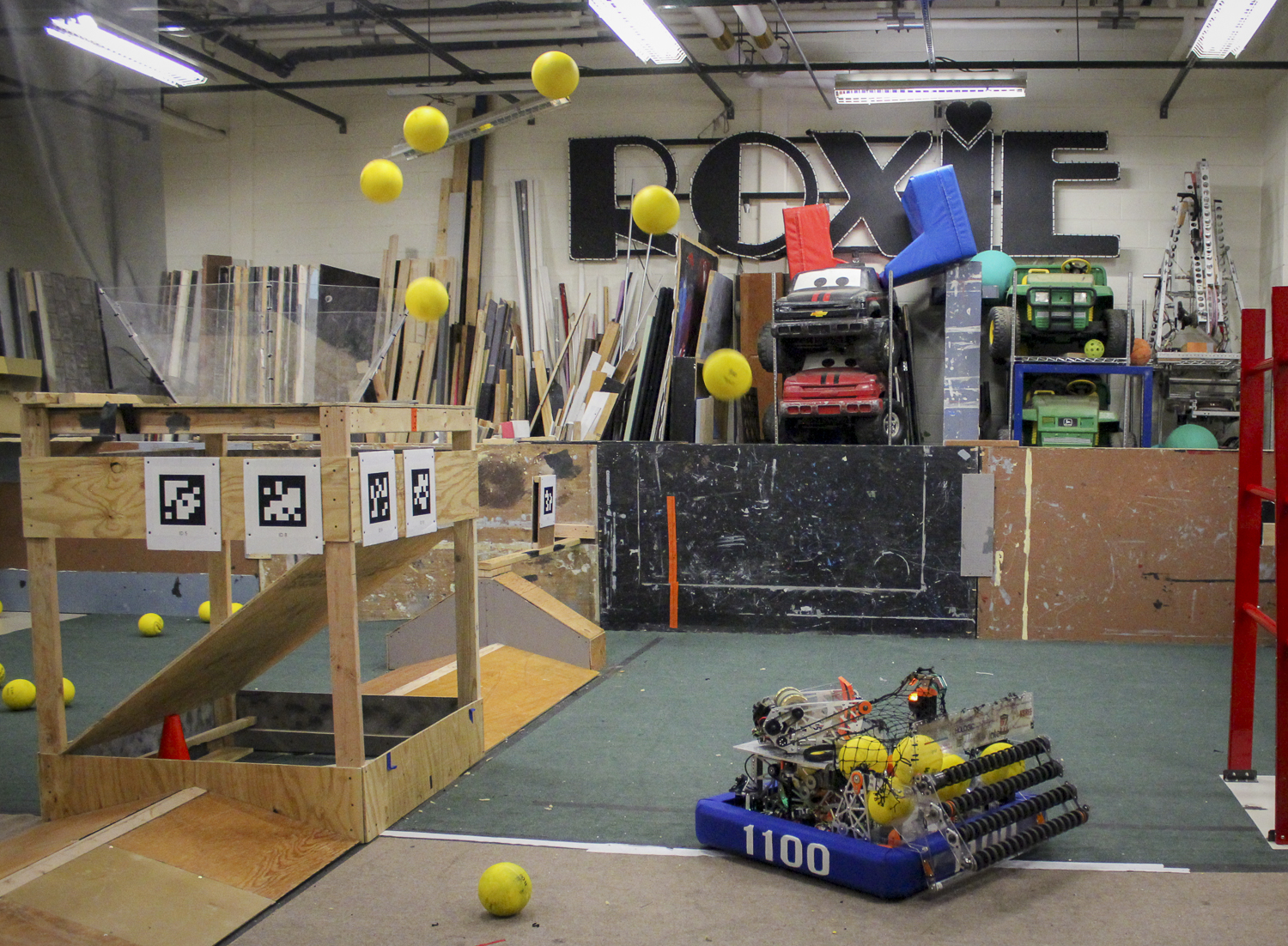
The team participates annually in the FIRST Robotics Competition (FRC) and meets multiple days a week throughout the year, starting to build their robot once the year’s challenge is released in January. This year’s game, “Rebuilt,” involves shooting yellow balls (called “fuel”) into a basket (called the “hub”), as well as a ladder the robot can climb for extra points. “Rebuilt” is different from typical games because of its high point value, with scores into the seven hundreds, and rules that allow for a person on either side of the field to throw balls into the hub.
Since qualifying for the New England District Championship, the team has been excited for the opportunity to advance to the next round, the World Championship, which will be held at the end of April in Houston. In the 2025 competition season, Inverse Polarity’s robot ranked in the mid twenties of about 100 teams at the District Championship, which was enough to qualify for the World Championship, but the team ultimately chose not to go due to short notice and concentrated on this year’s efforts instead.
“The team [last year] was getting better every competition, and then we did better than we thought we would, so we got caught off guard,” adviser and lead mentor Dan Strickland said. “We hadn’t done all the planning that was necessary to get a trip [to the World Championship] together.”
Since there were only two seniors on Inverse Polarity’s team last year, most members still have a chance to go. In order for everyone to go at least once, the team aims to go to Worlds at least once every four years.
“If everyone was a senior, we would have put a lot more effort in if they hadn’t gone before, so that was one of the other factors that was involved with making the decision,” Strickland said.
The team, whose main goal has been improving the robot, spends each Friday meeting working on the robot, having a potluck dinner, holding a team meeting and returning to work. Inverse Polarity is split into several subteams that work together, including categories like software, mechanics, strategy and outreach. The team chooses not to assign permanent roles and instead let members join any subteam.
“[Members] generally just sit down [at the subteam] that they find enjoyable, or also move around between them, and do what they want to do,” junior co-captain Oliver Gaskamp said. “We find that to be a better environment for learning.”
Although the 58 member Inverse Polarity team mostly consists of underclassmen, they have found it easy to adapt to the team since most of them participated in the FIRST Lego League and FIRST Tech Challenge (FTC) programs during middle school. This year, the team also provided new robotics members the opportunity to build a robot for last year’s game in order to get hands-on experience during the off-season.
“There wasn’t much they had to do to help us get used to the environment because all of the people there are really helpful,” freshman Shantanu Shroff said. “At the first meeting they had a bunch of parent volunteers come in and we did a bunch of team building activities.”
When the robotics season kicks off in early January, the team splits into multiple subteams, brainstorms strategies, discusses and then designs. The subteams work on tasks such as Computer Aided Design, prototype manufacturing and coding the autonomous portion of the robot. Each year’s robot is unique as it is designed for the current game.
“[This year], we realized immediately that we need to be able to shoot a lot of fuel really quickly,” junior software lead Calvin Midgley said. “So we’ve designed it to be able to just shoot from anywhere to anywhere, and also take in a bunch of fuel at the same time.”
The team usually attends three regional competitions each year. To place well enough to qualify for the Districts Championship, teams gather “district points” at each competition, but do not necessarily need to place in order to advance. Each competition lasts two days, with a qualification match on the first day and playoffs on the second.
“[The competitiveness level] depends on which teams are there, because there are some teams that put everything into their robot,” junior co-captain Caitlin Palmer said. “It’s actually crazy how they find the time.”
At their first regional competition on March 14 and 15 in Springfield, which included 38 teams, Inverse Polarity reached the quarter finals and received the Sustainability and Student Leadership awards. Although the team struggled in qualifications due to mechanical and electrical issues with the robot, they improved the next day during playoffs.
“We were really rushed at the end [leading up to the competition]… but on our second [competition day], we got it along,” Gaskamp said. “We figured it out, and we did a lot better. It was really impressive to see that growth because we improved drastically.”
In addition to placing well in competitions, raising money has been another integral part of the team’s jobs as the regular competition season expenses are $40,000 and a trip to Worlds doubles that cost. The team has fundraisers and sponsors, as well as a parent fundraising group, which recently wrote a grant for $10,000 and has played an important role in the team’s success.
“The school doesn’t provide any financial support, but they do give us space, which is very helpful,” Palmer said. “We love the space that we’re given, but we do have to find our money from outside sponsors.”
Since their second regional competition at Worcester Polytechnic Institute (WPI), the team won the Judge’s Award, is ranked 50th out of 200 teams in New England and qualified for the District Championship, which is from April 16 to April 18 in Springfield. There will be 92 teams attending, and the top teams will then go to Worlds.
“Making sure that we are ready for a [potential trip to the World Championship] has been one of the main things that we have been doing this year, right from the beginning,” Strickland said. “We hope everything will work out, but you never know.”
As the season continues, the team wants to improve their camera sensors’ abilities and be able to shoot fuel while the robot is moving. Still, Inverse Polarity believes they have seen major improvements since previous seasons.
“[This year], the planning side of things, communicating to the wider team and what’s going on with the robot has gotten much better,” sophomore scouting lead Felix Benoit said.
Despite Inverse Polarity’s success in recent competitions, other teams’ improvements push them to work even harder. The team is also busy with other tasks, like participating in the button-making tradition, where teams will trade buttons with each other at competitions, applying for awards and selling merchandise.
“We’re never finished,” Midgley said. “We’ve always gotten more to work on and try and improve.”



Mila • May 28, 2026 at 9:48 pm
Yay! Amazing article 🙂