


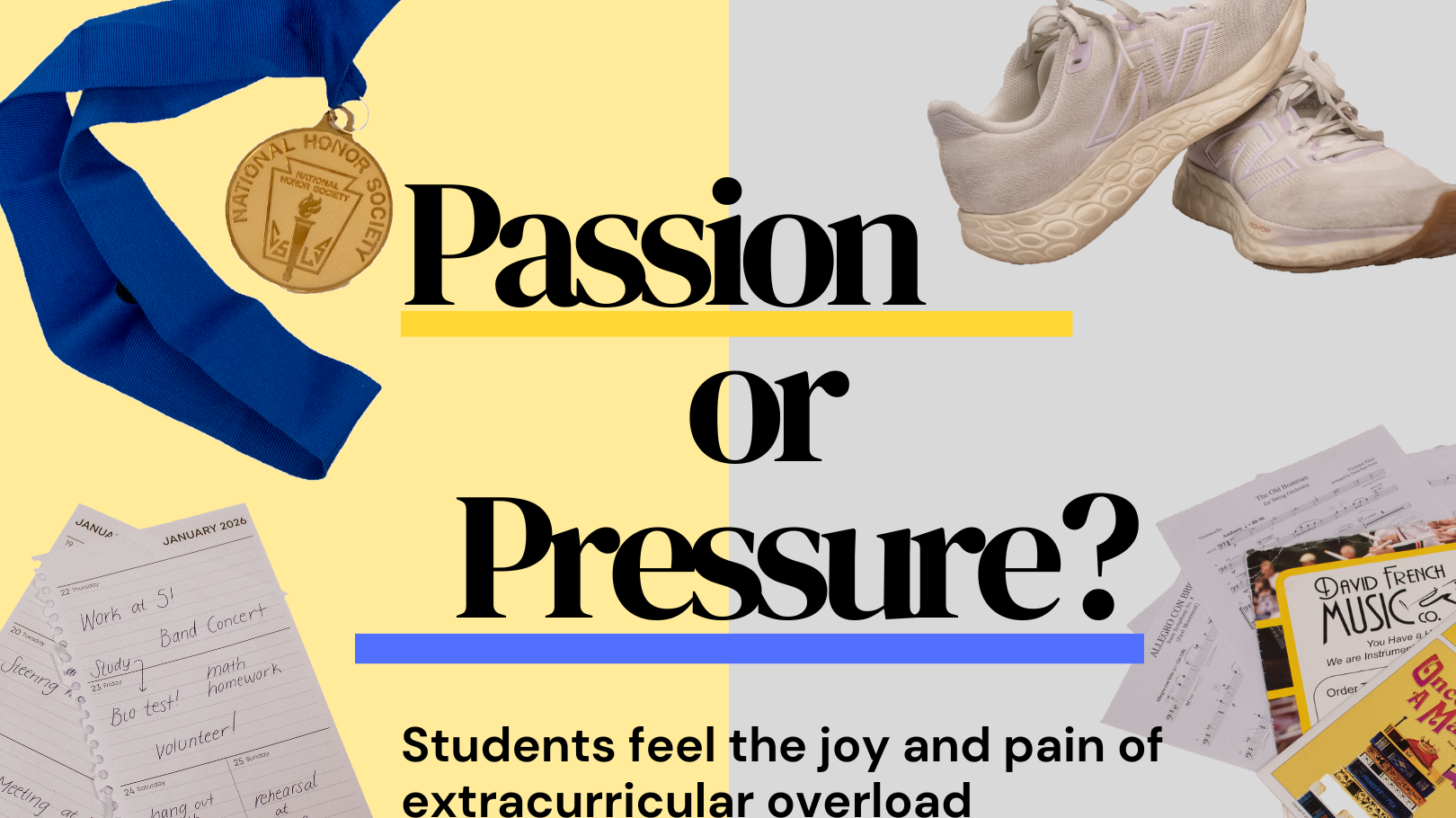

Today, a majority of students face the pressure of college competitiveness, and as a result are taking on more rigorous courses and joining more clubs, sports and other extracurricular activities, which leads to stress in an area most believe should be focused on fun and exploring personal interests.
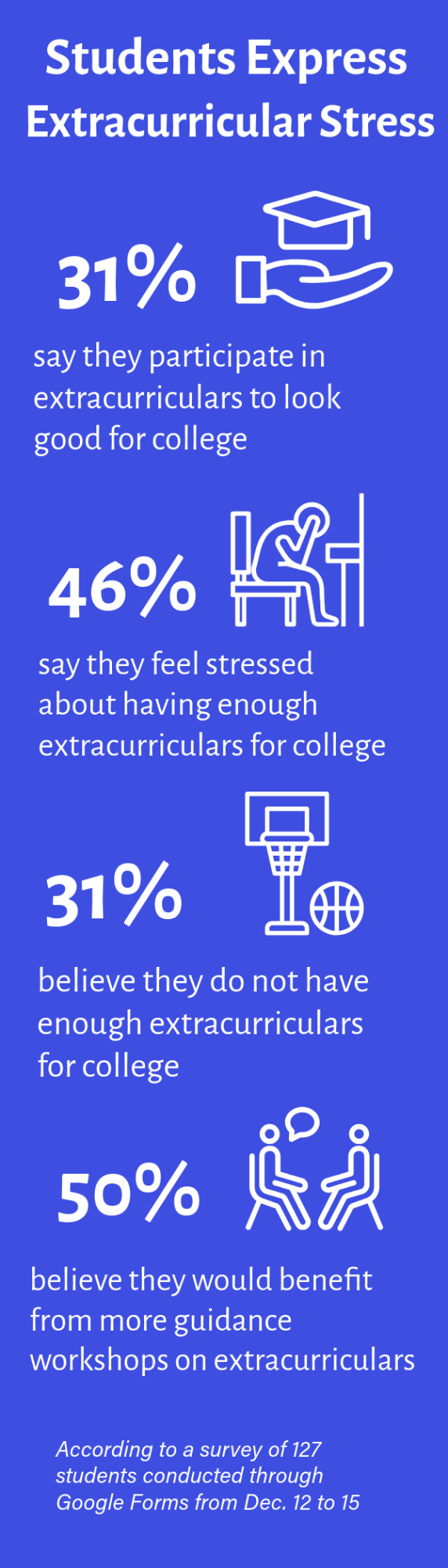
According to a Harbinger survey of 127 students from Dec. 12 to 15 through Google Forms, 41% of students are currently participating in five or more extracurricular activities, and 15% of students spend more than 14 hours a week participating in extracurriculars.
Principal Sean Bevan noticed a dramatic shift regarding the importance of extracurriculars post-pandemic when many colleges and universities went SAT optional.
“What I’ve seen as principal is a rapid expansion in the last three or four years of the creation of clubs that didn’t formerly exist and the number of club proposals brought to me,” Bevan said.
Bevan believes this shift occurred due to students being compelled to distinguish themselves through extracurricular activities instead of standardized test scores. As a result, there has been a surge of club proposals over the past few years. Due to this surge, the school employed a formal, more rigorous club application process this year.
Head of Guidance Lisa Connery also noticed an increase in competitiveness in college admissions, which may have increased student stress.
“There’s definitely competitiveness within the admissions process, and so I think there’s been a rise in students taking on more [extracurriculars] in hopes of being admitted to a school,” Connery said. “I’ve seen, as a result of that, maybe a rise in some stress related to it.”
Extracurriculars have traditionally been intended as a platform for students to socialize while exploring personal interests and career fields they may want to go into. However, in an effort to build the most competitive resume possible, they have recently felt more like required obligations rather than a genuine desire.
31% of the Harbinger survey respondents reported their primary reason for participating in extracurriculars is to build their resume and look good for college applications, and 78% said that this this was at least part of the reason for their participation.
Career Coordinator Michelle Kaelin suggests students should focus on activities that align with their interests. For example, if someone is interested in biology, they should look more into STEM extracurriculars. However, she also suggests that students shouldn’t stay with these extracurriculars within their field of interest if they don’t want to, as she believes participating in extracurriculars unrelated to your career field is just as important.
Kaelin and Bevan also both recommend that, from a college admissions standpoint, students should consider activities with a wider impact.
“All colleges, like any community would, want to have community members who are contributing to their community,” Kaelin said. “So, if you go through high school and if you’re not engaged in anything [or] doing anything, [college] might feel like you’re probably going to do the same thing when you’re on campus.”
Bevan believes making a broader impact is more important than students stretching themselves thin with as many extracurriculars as possible.
“From what I understand, college admissions offices really look for students who can deliver a measurable, observable impact on their community,” Bevan said. “I think that would be more impressive than a student who’s participating in a lot of different clubs that have not delivered measurable, impactful results on their community.”
Despite the endless expectations colleges have for high school students, many of these seeming expectations may just be myths and false assumptions. One of these false assumptions, according to Kaelin, is the idea that one type of extracurricular is more significant than another. Although this can be true when comparing a one hour club that occurs once a week to a part-time job that is done multiple hours a week, Kaelin believes the overall assumption that some extracurriculars are better than others is false.
“Honestly, I don’t feel like there’s a better or worse [extracurricular],” Kaelin said. “I think it’s about doing what is good for you, because your better and my better might be two very different things.”
Another false belief students have is that colleges expect a certain number of extracurriculars from prospective students. 36% of Harbinger survey respondents believe they do not have enough extracurriculars for college. But in reality, colleges do not look for numbers of extracurriculars, but rather the types of extracurriculars you do.
“It’s really not about how many,” Connery said. “It’s about finding a few things that are meaningful to you, that you’re passionate about, and then expanding on that, whether it’s through leadership or the larger community.”
While most students view extracurriculars as a means toward resume-building, Kaelin believes this is not healthy, and that students should look at extracurriculars from a different angle.
“I just really suggest that [students] follow their interests and use extracurriculars as a way to explore [their] interests, and learn about themselves and what they like and don’t like,” Kaelin said.
According to Kaelin, one of the most important considerations when it comes to extracurriculars is not only time management, but also having a good understanding of your schedule and how many extracurriculars you can fit in.
“You might be able to handle five extracurriculars all at once, but somebody else who’s working a part time job 10 hours a week might not have time for any extracurricular activities,” Kaelin said.
And sometimes, some students may not have any room for extracurriculars due to personal or family obligations.
“[Colleges] won’t necessarily hold it against you because there might be some students who simply can’t,” Connery said. “They might have a responsibility at home with a grandparent, or they may have younger siblings they have to take care of.”
Another important factor when it comes to choosing extracurriculars is enjoyment, and is also the main reason why some of the Algonquin student body choose to do an extensive amount of extracurriculars throughout the school year.
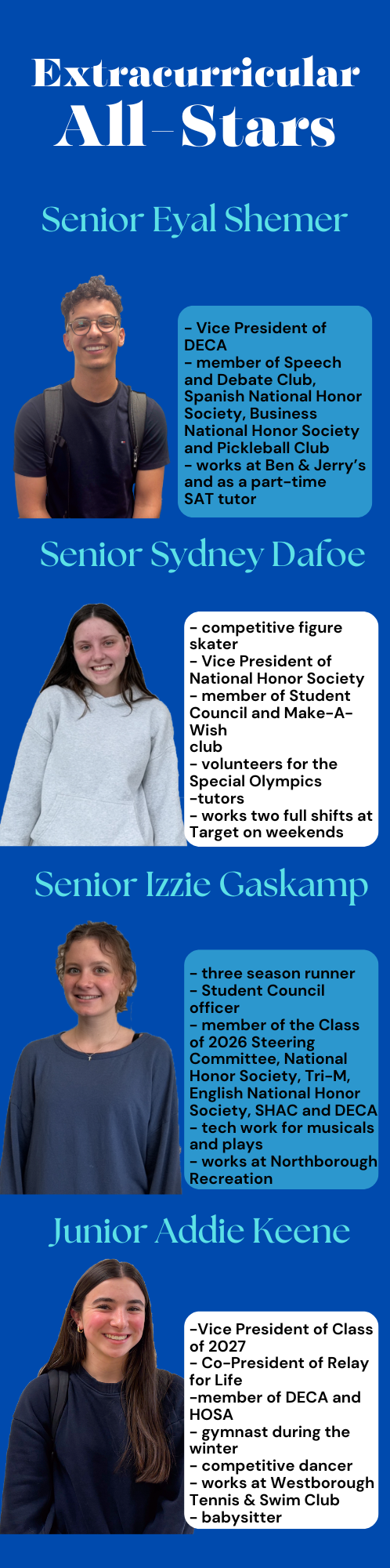
Junior Addie Keene is the class of 2027 vice president, co-president of Relay for Life, a member of DECA and HOSA, a gymnast during the winter, a competitive dancer outside of school, holds a job at Westborough Tennis & Swim Club, and babysits often throughout the school year. Keene enjoys her activities and mainly uses extracurriculars in order to explore different career fields.
“I am not totally sure what I want to major in or do as a job, so I want to explore several things,” Keene said. “Being a part of HOSA and being a part of DECA is just trying out new things that I wouldn’t be able to do just in my classroom.”
Senior Eyal Shemer is vice president of DECA and a member of Speech and Debate Club, Spanish National Honor Society, Business National Honor Society and Pickleball Club. He also holds jobs at Ben & Jerry’s and as a part-time SAT tutor. His main time management strategy around his many extracurriculars and schoolwork is prioritization.
“Prioritize the things that you know you can do well,” Shemer said. “Because if you can do them well, then the time you spend doing them won’t be seen as work. You’ll see it as just assisting people, and that makes the work that you do much more enjoyable.”
Senior Sydney Dafoe is a competitive figure skater, a member of student council for the Class of 2026, vice president of the National Honor Society and a member of the Make-A-Wish club. She volunteers for the Special Olympics, tutors her neighbor’s son with disabilities and works two full shifts at Target during the weekends. Despite her overflowing schedule, Dafoe has learned throughout the years to prioritize her mental health and how to say no to certain things.
“It’s good to say no to something,” Dafoe said. “So if my friends ask to do something, it’s good to just learn how to say no, and just tell myself that I actually just need to take some time for myself and relax, get myself caught up.”
Senior Izzie Gaskamp is a three season runner, student council officer and member of the Class of 2026 steering committee, National Honor Society, Tri-M (Music National Honor Society), English National Honor Society, SHAC (Spreading Hope Across Continents) and DECA. Additionally, she also does technological work for musicals, plays and small shows at school, and holds a job at Northborough Recreation.
Gaskamp participates in many extracurriculars because she is interested in all of them.
“I really like talking and interacting with other people a lot,” Gaskamp said. “A lot of these extracurriculars allow me to do that.”
Gaskamp also loves how Algonquin offers a wide range of extracurriculars that she can participate in.
“We have so many opportunities here, so then I’m also motivated by the fact that I can do so many things,” Gaskamp said. “I’m like, ‘Why wouldn’t I if I can?’”
Gaskamp says one of her best strategies is to make lists of all of her tasks. She first makes a list with all of the tasks that need to be done, decides what are the most important and what is the least important tasks, and then makes a priority tasks list with the tasks that are the most important, and then focuses on what is the most important tasks on list with the priority tasks lists.
“[Making a list] is something that really helps primarily visualize what I need to do on a day to day basis,” Gaskamp said. “I like to see that I’m making progress.”
All of these students say they participate in a multitude of extracurriculars simply due to their own interests and passions, and not to impress colleges nor to satisfy parental pressures.
“If you’re just focused on doing [extracurriculars] to look good for college, then you’re really going to burn out easier than if you’re doing this for yourself,” Dafoe said.




Amanda • Apr 8, 2026 at 7:23 am
Without having experienced the college prep before covid I wouldn’t have known it wasn’t always like this. Hopefully as messages like the one in this article get shared, there can be a shift toward a more balanced approach to finding your way into adulthood.