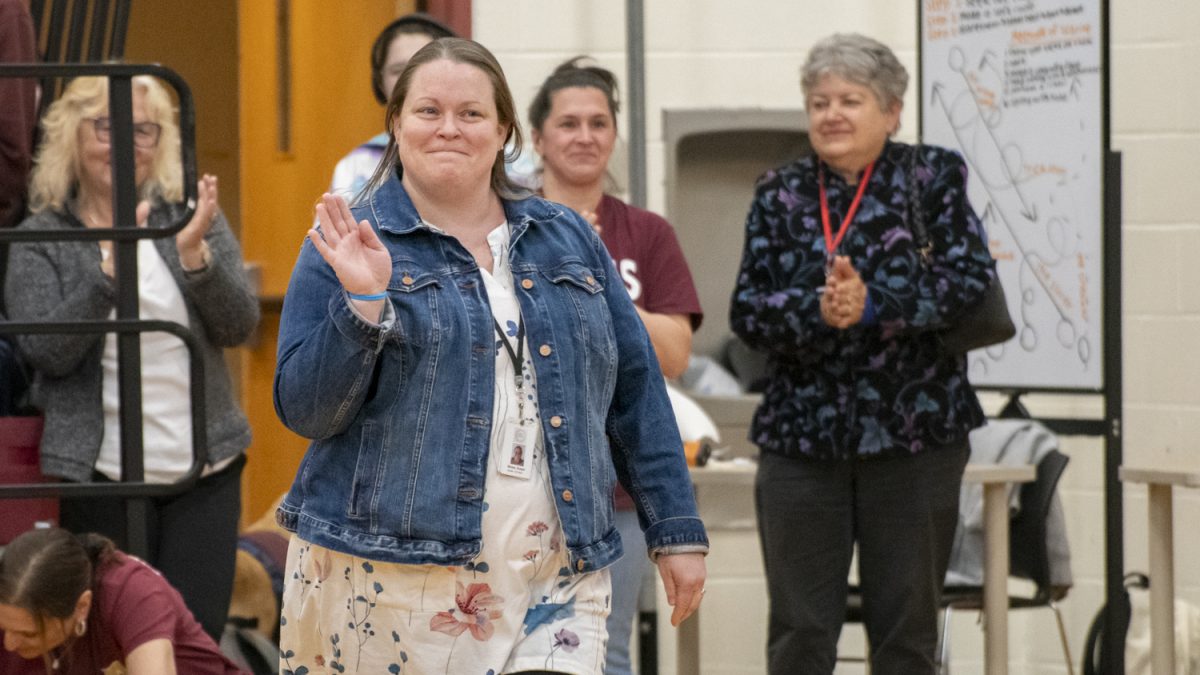




Culinary arts teacher Zbigniewa Giegucz and her daughter, Educational Support Professional Stefani Giegucz, promote full-inclusion both locally and abroad. Last summer, they visited Bulgaria to collaborate with the Bulgarian Sports Academy for students with disabilities.
Ten years ago, Zbigniewa Giegucz—with a grant from Special Olympics—founded the Algonquin Unified Basketball and Unified Track teams, where students with intellectual and/or developmental disabilities (IDD) can participate on teams alongside general-education students, just as her daughter did during her own childhood.
Stefani Giegucz’s passion behind this work is deeply personal. Born without her left hand, she grew up believing that independence builds strength, something that she achieved through sports. In high school, Stefani Giegucz played on the varsity unified basketball team and the unified color guard team where she twirled flags while dancing.
“People look at me and they’re like, ‘Oh you can’t do that,’…Yes I can!” Stefani Giegucz said. “I like to prove people wrong.”
Zbigniewa Giegucz believes all students deserve opportunities like her daughter had.
“I see kids and I see potential, but you have to give them somewhere—an ‘avenue’—to learn,” Zbigniewa Giegucz said.
Stefani Giegucz also agreed that giving students opportunities to try, and even to fail, is key to growth.
“You can do anything; there are obstacles…it’s finding ways around those obstacles,” Stefani Giegucz said.

In fact, the Gieguczes quickly found that special education students often accomplish things people automatically assumed they were incapable of.
“Those kids shine,” Zbigniewa Giegucz said. “But they didn’t know they had it in themselves because sometimes they weren’t given the opportunity to.”
In 2025, the Special Olympics asked the Gieguczes to host delegates from the Bulgarian Sports Academy, a program for students with IDD. The chief assistant of the department Mariana Borukova wanted to see how the Algonquin unified sports programs worked in hopes of strengthening Bulgaria’s own. In a country where sports are deeply loved, Zbigniewa Giegucz said they offered the perfect path toward social integration.
“You can play basketball, you can play badminton, whatever, as long as you have some skills,” Zbigniewa Giegucz said. “You don’t have to speak the language; you can just do it together.”
Borukova invited the Gieguczes to visit Bulgaria during the summer to experience their inclusion program firsthand. The trip fostered collaboration between the two countries and encouraged Bulgaria to continue its fight for full inclusion.
“[We worked to help show] that another country can do it; [Bulgaria] can do it,” Stefani Giegucz said. “It can be implemented; you just got to keep going.”
During the trip, the Gieguczes observed unified sports practices, from tennis to basketball and even athletes at equestrian riding stables. They also spent a week at a water sports center teaching kayaking, paddleboarding and sailing, encouraging students to challenge themselves.
“Some kids had a hard time getting into the boat, some kids were afraid of the water, so we helped them overcome their fears,” Zbigniewa Giegucz said.
When the students persevered, the Gieguczes felt proud.
“I get this bubbly, fuzzy feeling in my chest that expands through my whole body,” Stefani Giegucz said. “It makes me happy and full of pride.”
The Gieguczes not only helped students face their fears, though. Together, they pushed the kids to their full potential.
“Let’s do what you can do, and keep pushing you further,” Stefani Giegucz would tell the kids.
Throughout the week, the Gieguczes agreed that everyone directly involved with the Sports Academy was deeply committed to inclusion.

“It was very obvious that the general-education kids wanted to be there, that they were passionate about it,” Stefani Giegucz said. “It was very purposeful.”
Bulgaria’s road to inclusion, however, is still long. After emerging from communism less than 20 years ago, the country still faces stigma around IDD. When the Gieguczes discussed U.S. unified sports programs with diplomats at the Bulgarian Embassy, Stefani Giegucz said it was clear that unlike the Sports Academy staff, the Ministry of Education representative did not share their enthusiasm.
“We were all just staring at him—get with the program,” Stefani Giegucz said.
This lingering stigma has real consequences: special-education programs remain severely underfunded.
“Their rackets and their equipment in some places, it’s like, ‘Really? You’re playing with this?’” Zbigniewa Giegucz said.
Despite these challenges, Borukova’s goal is to achieve full inclusion with the Gieguczes’ help.
“It’s a process—it doesn’t just happen overnight and I think they’re headed in the right direction,” Zbigniewa Giegucz said.
To raise money, the Gieguczes plan to host a Jamboree from Dec. 13-14. There, a team of more than 30 students with IDD from Bath, Maine will come to Algonquin for a weekend filled with clinics, drills and a final Sunday game. Giegucz’s culinary-arts students will also cater the event, reinforcing the idea of inclusion.
“It’ll be nice for our kids to see other kids from other states who are like them, and I think that’ll make them feel good, and maybe they’ll make nice new friendships,” Zbigniewa Giegucz said.
The Gieguczes’ commitment to inclusion everywhere captures what they hope people will learn from them.
“We need to help each other,” Stefani Giegucz said. “No matter where we’re at, no matter who we’re with, we need to be helping each other.”