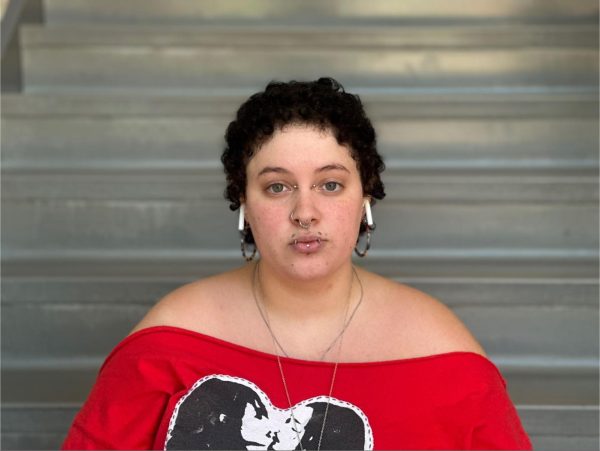



Intricately carving away at a block or making prints with colorful inks in the AP art room, senior Paige Furst is incredibly dedicated to and passionate about the craft of printmaking.
Furst has always had a deep fascination and adoration for the arts, leading them to become one of the co-presidents of the Algonquin Art Honor Society. Furst can trace their love for this art form to their grandmother and art teacher Rebecca Duffy. Block-printing involves carving designs into a block with fine blades, usually with the intention of later inking it and transferring the print onto a separate surface. Furst uses a soft linoleum block for most of their printing, a commonly used surface in this medium.
Block-printing has almost always been a part of Furst’s life.
“My grandmother was an ‘all levels’ art teacher, and she would teach printmaking to her students,” Furst said. “So she taught me how to do linoleum-cut prints in first or second grade. I just kind of forgot about it; then we did it again in Mixed Media, and it reminded me how much I loved that medium.”

They participated in Algonquin’s Mixed Media elective with Duffy as a sophomore, reigniting their passion for block-printing. Furst began to fall deeply in love with this medium, later utilizing it for other art projects.
“We did the animal prints, and I did a secretary bird, which is one of my favorite birds,” Furst said. “I think they’re very pretty. Afterwards, we got to do more complex prints, and I did a kind of clown. That was my first attempt at doing a proper reduction print, where you do the multiple layers with different colors, and it made me really stick with that medium more.”
Furst explained the process of reduction block-printing, which they really enjoy.
“[A reduction print] is when you have a block of soft linoleum and you plan out a design,” Furst said, “Basically, [you] carve out the parts that you don’t want to show up on the print, pretty standard block printing process, but with this kind it’s that you carve out the small bits that you don’t want to be asserting color to. You print it once, carve out more, then print it with a different color on top. It creates a really cool, layered effect.”
Furst utilizes different aids in their printmaking, such as a digital program called Procreate, which they use to draw as well as to invert lettering for their prints.
“[Making digital mockups] is definitely really helpful,” Furst said. “You’re able to futz around with dimensions and contrast a lot digitally without feeling like you’re really burdened by wasting a block. It makes it so planning stuff out like that is a lot easier.”

Furst is ambitious in their craft, once creating an 11×17 print of a fake clown band poster for their Mixed Media elective. They are constantly finding new and innovative ways to take their printmaking to the next level, including transforming digital art into block prints.
“I transferred a lot of my favorites [drawings] into digital sketches and refined those there, eventually saved them, inverted them and started trying to transfer them over onto blocks,” Furst said. “For the most part, I tend to freehand, doing transfer stuff. I don’t love having to print it out and trace it; I find that a little bit more tedious, but usually I have the soft-cut linoleum and I sketch with either a paint pen or a permanent marker, and then go about marking where I want to carve. And then I just spend a couple hours just carving it out, and then eventually do four-ish prints just to see the range of texture I can get.”
Furst is a pillar of their community of artists, supporting and helping others learn from their skill and expertise. Senior Linden Shaffer, a fellow artist and close friend, values Furst’s creativity and kindness.

“They’ve helped me a lot with my creative journey personally,” Shaffer said. “I look up to them so much when it comes to art, and having them as a classmate and peer for AP Art last year in the studio was such an amazing experience. It was very helpful, and seeing them interact with everybody else in that class was wonderful as well because people would rely on them to give really great advice.”
Block-printing is more than just a hobby for Furst; they hope for it to become their whole life, creating while teaching others about it.
“One of my personal dream jobs is to be a studio instructor for independent classes outside of school,” Furst said. “I remember doing a lot of mixed media work in those classes when I’ve taken them, personally. I think it would be really fun to teach people how to do it and also spread the practice of printmaking because it’s one of the oldest art forms ever, and I think it’s one of the coolest. I think teaching younger people to do it would be really cool, and it would make me feel really proud.”